


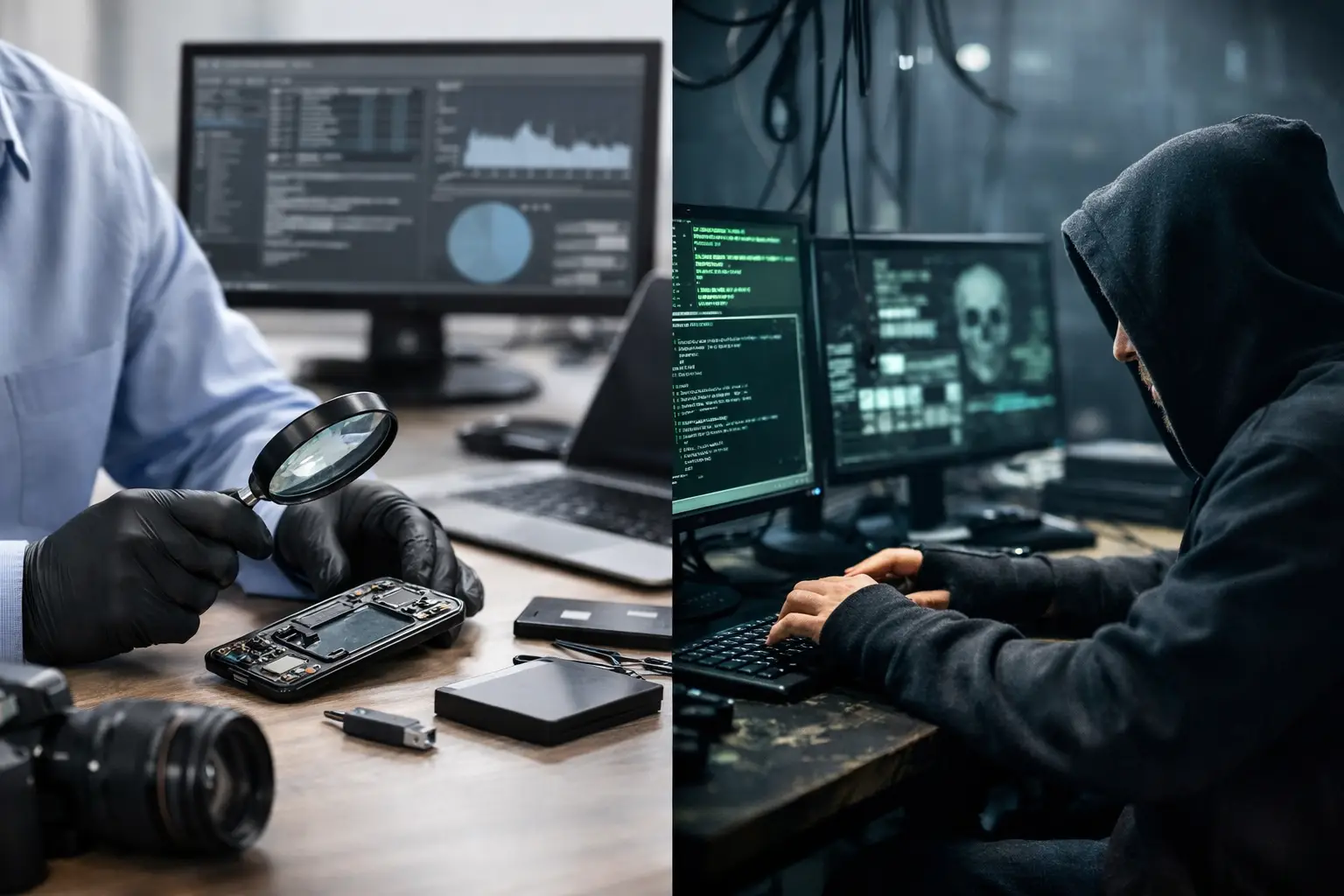
Digital Forensics vs Hacking for Legal Cases
A deleted text message, a suspicious login alert, or an unfamiliar account charge can make people feel they need to get into someone else’s device immediately. But digital forensics vs hacking is not a matter of two different names for the same activity. The distinction determines whether information is collected lawfully, whether it can support a legal case, and whether the person seeking answers creates new risks for themselves.
For individuals facing a divorce, custody dispute, suspected infidelity, fraud, or harassment, the urge to search a spouse’s phone or access a business account can be understandable. It can also expose them to criminal liability, civil claims, and evidence that cannot be used in court. A professional investigation begins with a different question: What information can be legally obtained, preserved, authenticated, and presented with confidence?
Digital Forensics vs Hacking: The Core Difference
Digital forensics is the lawful identification, preservation, examination, and reporting of electronic evidence. Its purpose is to determine what occurred on a device, account, network, or digital platform while protecting the integrity of the data. The work may involve recovering deleted files, documenting communications, identifying signs of data transfer, analyzing system activity, or tracing the source and timeline of suspicious events.
Hacking generally involves accessing a computer system, account, device, or network without authorization. It may include guessing passwords, installing spyware, bypassing security measures, intercepting communications, or entering accounts through credentials that do not belong to the user. Even when a person believes they have a good reason, unauthorized access can violate federal or state law.
Intent does not erase the legal problem. A spouse who accesses a partner’s private email account to look for proof of an affair, for example, may still be accessing a protected account without permission. A business owner who enters an employee’s personal cloud storage account may face similar concerns. The details matter, including ownership, consent, workplace policies, shared credentials, and the terms governing the device or account.
Digital forensics works within those limits. Hacking crosses them.
What a Lawful Digital Forensic Examination Can Do
A qualified digital forensic investigator does not promise access to every device or account. Instead, the investigator assesses what can be examined with proper authority and what evidence may already be available through legal channels.
With the owner’s informed consent, a forensic examination can often review a phone, computer, external drive, cloud backup, or business system. In litigation, an attorney may use discovery procedures, subpoenas, preservation demands, or court orders to obtain information from the opposing party or a service provider. Law enforcement may have additional authority when conducting a criminal investigation, but private investigators do not possess law enforcement powers.
Within an authorized scope, a forensic examination can help answer focused questions. Was a document deleted or altered? Did someone use a computer at a particular time? Was confidential business data copied to a removable drive or sent outside the company? Does a phone contain messages, location-related records, images, or application activity relevant to a dispute? Has evidence of fraud or unauthorized use been preserved before it disappears?
The answer is not always simple. A deleted file may be unrecoverable if it has been overwritten. Encryption, damaged hardware, remote data deletion, and platform retention policies can limit what is available. A reputable investigator explains those limitations early rather than overstating what technology can produce.
Why Evidence Handling Matters in Court
A screenshot can be useful as a lead. It is not automatically reliable evidence.
Screenshots can be cropped, edited, taken out of context, or difficult to authenticate. A forensic process is designed to preserve more than the visible content. It documents where the evidence came from, how it was collected, who handled it, and what steps were used to protect it from alteration. This record is commonly called the chain of custody.
For sensitive matters, an investigator may create a verified forensic image of authorized media rather than work directly from the original device. The original is preserved, while the analysis occurs on a verified copy. Hash values, which function as digital fingerprints, can help demonstrate that the copied data remained unchanged during examination.
That discipline matters in family law, civil litigation, internal corporate investigations, and criminal defense support. Attorneys need to understand not only what a digital record appears to show, but whether they can establish that it is genuine, complete, and lawfully acquired. Evidence gathered through improper access can become a liability instead of an advantage.
Common Situations Where the Line Gets Blurred
Shared devices create frequent confusion. A couple may share a home computer, a tablet, or a wireless network, but that does not necessarily give either person unrestricted authority to access the other’s private email, banking, social media, or password-protected applications. Shared property and shared access are not always the same as legal consent.
Workplace cases require similar care. An employer may have authority to review company-owned devices and accounts, particularly when clear written policies notify employees that systems may be monitored. That authority may not extend to personal accounts, personal phones, or private communications. Before an internal investigation begins, the scope should be reviewed with legal counsel and tailored to the organization’s policies and the facts at hand.
Parents may also assume they can access a child’s accounts without concern. The appropriate approach depends on the child’s age, the account involved, the family circumstances, and applicable law. When safety is at issue, preserving available information and seeking qualified guidance is usually wiser than taking actions that could compromise evidence or escalate a dangerous situation.
Avoid These Shortcuts
When someone suspects deception or misconduct, quick answers can be tempting. Installing spyware, using a hidden keylogger, recording communications without understanding consent laws, guessing a password, or logging into an account left open on a device can carry serious consequences. So can asking a friend with technical skills to obtain information through unauthorized means.
These methods may also put the target on notice. A person who discovers spyware or suspicious account activity may change passwords, erase records, move assets, or alter their behavior. The result can be less useful evidence and more risk.
A better first step is to preserve what is already available lawfully. Save original messages and emails without editing them. Keep dates, times, user names, and relevant context. Photograph physical evidence if appropriate, but do not alter or destroy the source. Write down what you observed and when you observed it. Then speak with a qualified investigator or attorney before accessing additional information.
The Value of a Professional Strategy
Digital evidence is rarely the entire case. A suspicious text may need to be evaluated alongside financial records, witness statements, surveillance findings, employment records, public information, or other legally obtained evidence. The strongest approach is usually a case-specific strategy that identifies the question to be answered, the lawful sources of proof, and the method for preserving findings.
For example, in a suspected corporate theft matter, the central issue may be whether proprietary files left the company and who had authorized access. In a divorce case, the issue may be whether financial records reveal concealed spending or assets. In a custody matter, the relevant evidence may concern safety, communications, or conduct directly affecting the child. Each situation calls for a different scope, and not every digital lead deserves a full forensic examination.
At Kay & Associates Investigations, discretion is part of the investigative process. Sensitive cases require careful planning, clear communication, and respect for the legal and emotional stakes involved. The goal is not to collect every possible piece of information. It is to obtain verified, relevant intelligence without placing the client or the case at unnecessary risk.
When to Seek Help Quickly
Time can matter when there is a credible risk that data will be destroyed, accounts will be emptied, a business system has been compromised, or a person’s safety is in question. Do not attempt to retaliate digitally or confront a suspected actor through their accounts. Preserve what you can lawfully access and seek prompt professional guidance.
If there is an immediate threat, active stalking, extortion, threats of violence, or a suspected crime in progress, contact law enforcement or emergency services first. A private investigation can support a broader strategy, but urgent safety concerns require immediate action.
The most useful digital evidence is not simply the information that is found. It is the information that can be trusted, explained, and used without creating a new legal problem. Before taking action on a device or account, pause long enough to protect both your case and yourself.










Locating and Serving a Person Hard to Find for Legal Action says: