


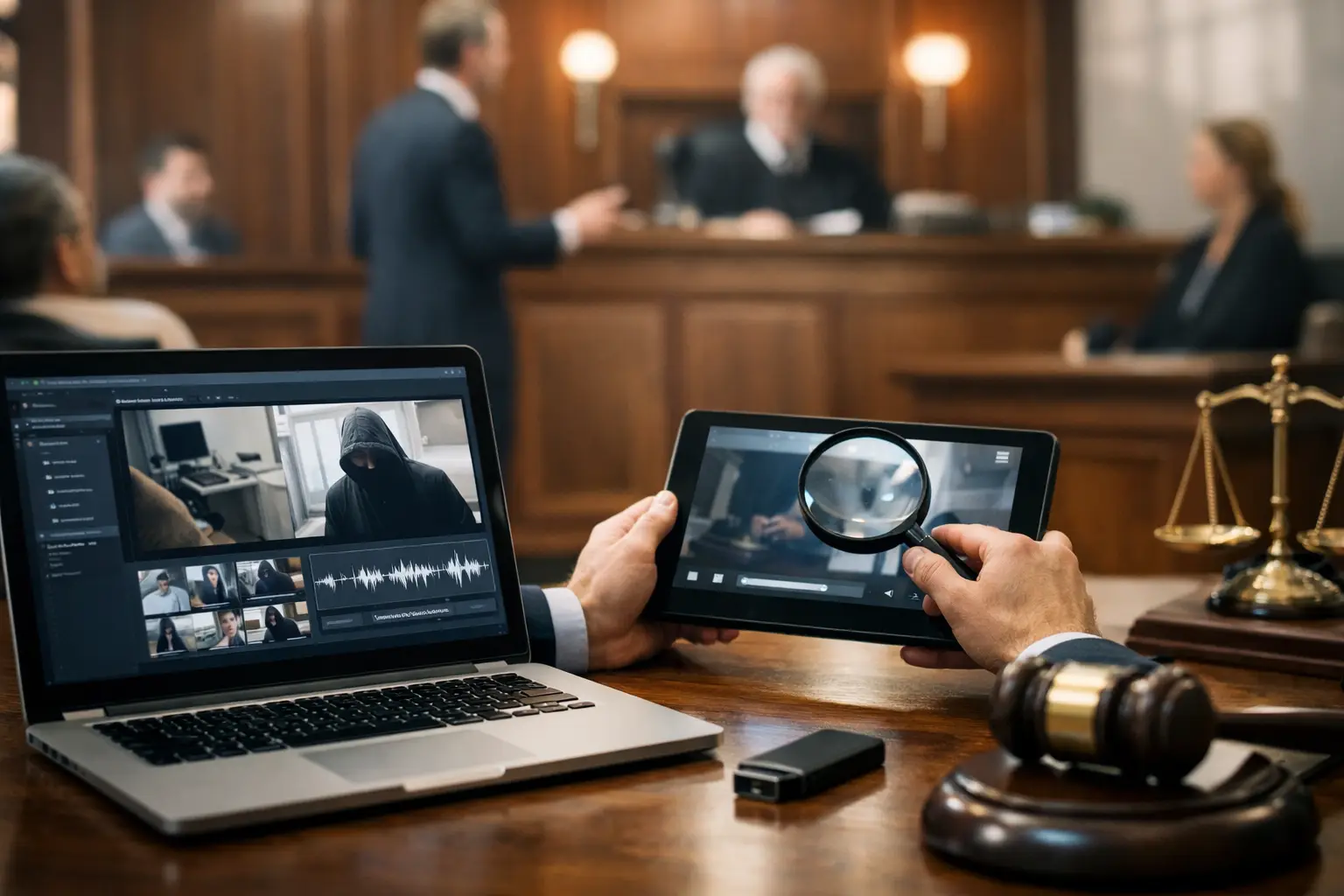
How Digital Evidence Gets Authenticated in Court
A screenshot can look decisive until someone asks the question that changes the case: Who created it, when was it created, and can anyone prove it has not been altered? That is how digital evidence gets authenticated. The process is not about claiming that a text message, video, email, or social media post is real. It is about being able to demonstrate it with reliable records, sound handling, and credible testimony.
For a divorce, custody dispute, fraud claim, internal corporate matter, or criminal defense case, digital evidence can be highly persuasive. It can also be challenged aggressively. A licensed investigator’s job is to help preserve the facts in a form that can withstand scrutiny while respecting privacy laws, court rules, and the client’s larger legal strategy.
What Authentication Actually Means
Authentication is the process of showing that a piece of evidence is what its proponent says it is. A party offering a text exchange may need to establish that the messages came from a particular phone or account. A party offering surveillance video may need to show where the footage originated, when it was recorded, and whether it was edited.
Authentication is not the same as proving every statement in the evidence is true. A message may be properly authenticated as having been sent by a specific account, yet its contents can still be disputed. It is also different from admissibility. Courts may exclude otherwise authentic evidence because it was obtained unlawfully, is irrelevant, unfairly prejudicial, or violates a rule against hearsay.
The standard can vary by jurisdiction and case type. In California, as elsewhere, the party offering evidence generally needs enough proof to support a finding that the item is genuine. The required proof may come from a witness with firsthand knowledge, account records, device data, distinctive characteristics, or digital forensic analysis.
How Digital Evidence Gets Authenticated Step by Step
The strongest evidence is handled carefully from the moment it is identified. Authentication usually begins long before a courtroom hearing.
Lawful collection comes first
The source matters. A spouse may lawfully provide messages received on their own phone, but accessing another person’s private account without authorization can create serious legal problems. The same concern applies to hidden tracking tools, intercepted communications, workplace devices, cloud accounts, and recordings.
A useful item obtained through an improper method may expose the collector to liability and complicate the legal case. Before collecting or sharing sensitive data, clients should speak with counsel or a qualified investigator who understands the boundaries. Professional judgment is particularly important in family-law and employee-related matters, where emotions often lead people to act before considering the consequences.
Preserve the original, not only a screenshot
Screenshots are convenient, but they are rarely the complete story. They can omit account names, timestamps, surrounding messages, device information, and the web address or application where the content appeared. They are also easy to crop, annotate, or manipulate.
Whenever possible, preserve the original device, original file, complete message thread, or native export. For social media content, investigators may document the profile name, post URL, date and time observed, visible comments, associated images or videos, and the method used to capture the material. For email, preserving the complete message and its header information can be far more valuable than printing the body of the email alone.
This does not mean a client should seize another person’s device or attempt to conduct their own forensic extraction. It means the legitimate source should be identified and preserved without unnecessary alteration.
Create a forensic copy and verify it with a hash
When a phone, computer, storage drive, or other device is examined, a trained forensic examiner typically creates a forensic image or a controlled extraction rather than working directly from the original whenever possible. This protects the source evidence and allows analysis to be repeated.
The examiner may calculate a hash value, often using an algorithm such as SHA-256. A hash is a digital fingerprint generated from the data. If even a small part of a file changes, its hash value changes. Matching hash values between the original and forensic copy help demonstrate that the copied data is an exact, unaltered match.
Hashing is powerful, but it is not a magic phrase that makes evidence admissible. It supports integrity. The examiner must still explain what was collected, how it was collected, and why the process was reliable.
Maintain a clear chain of custody
Chain of custody records each transfer and handling event from collection through review, storage, and presentation. It should identify who possessed the evidence, when they received it, what they did with it, where it was stored, and when it was transferred to another person.
A gap in the chain of custody does not automatically destroy a case. Courts understand that real-world investigations do not always unfold perfectly. But unexplained gaps give the opposing side room to argue that files were altered, substituted, mishandled, or accessed by unauthorized people.
Professional handling often includes evidence logs, secure storage, access controls, forensic copies, and documented transfers. These practices protect both the evidence and the client. In sensitive matters involving allegations of infidelity, child safety, theft, or financial misconduct, discretion is part of evidence preservation.
Connect the evidence to a person, account, or event
A phone number, profile, or email address alone may not prove who was behind it. Authentication becomes stronger when several independent details point in the same direction.
For example, a disputed social media account may be connected to an individual through profile photographs, posts referencing private facts, linked contact information, known associates, geolocation details, account-registration records obtained through legal process, or witness testimony. A text conversation may be supported by the recipient’s testimony, prior communications from the same number, billing records, device extraction data, or details only the sender would likely know.
Context matters. A single screenshot may be vulnerable to challenge. A consistent collection of original records, verified account information, contemporaneous notes, and witness evidence is substantially harder to dismiss.
Different Types of Digital Evidence Require Different Proof
Digital evidence is not one category with one solution. A video file, a deleted text message, a location record, and a spreadsheet each raise different questions.
Video authentication often focuses on the camera system, the person who retrieved the footage, recording dates, system settings, and whether the video is a complete export or a clipped segment. Metadata may help, but metadata can be missing or altered during copying. A knowledgeable witness and properly preserved original footage can be just as important.
Text messages require attention to the device, message thread, participants, dates, and account identifiers. Deleted messages may sometimes be recovered through forensic methods, but recovery depends on the device type, encryption, cloud synchronization, overwriting, and available backups. No ethical investigator should promise recovery where the underlying data may no longer exist.
Social media evidence is especially time-sensitive. Posts can be edited, deleted, made private, or removed by the platform. Prompt documentation can preserve what was publicly available at a particular time, but public availability does not eliminate the need for authentication. The investigator must be prepared to explain exactly what was observed and captured.
Location data can be useful in accident investigations, suspected fraud, custody disputes, and asset-related matters. Yet location data may show where a device was, not necessarily where its owner was. Shared devices, account access by others, inaccurate geolocation, and delayed uploads can affect interpretation. Strong investigations account for those limitations rather than overstating what the data proves.
Why Professional Documentation Protects the Case
Clients sometimes arrive with folders of screenshots, forwarded emails, recordings, and downloaded files. Those materials may contain valuable leads. But a lead is not automatically courtroom-ready evidence.
A professional investigator can help identify what should be preserved, document the source and collection method, maintain a defensible chain of custody, and coordinate with counsel when legal process is needed. Investigators can also distinguish between information that appears compelling and information that can actually be substantiated.
At Kay & Associates Investigations, digital evidence work is approached with the same discretion expected in any high-stakes investigation. The objective is not to collect the most material. It is to develop verified information that supports a client’s legal, personal, or business decisions without creating unnecessary risk.
Common Mistakes That Weaken Digital Evidence
The most damaging mistakes are often avoidable. Clients may edit a screenshot to make it easier to read, forward an email repeatedly until original header data is lost, log into another person’s account, confront a subject before evidence is preserved, or save files without recording where they came from.
Another common mistake is assuming technology is self-explanatory. A timestamp may reflect the device’s time setting rather than the actual time of an event. A profile name can be changed. A file’s creation date can describe a download or transfer, not the original recording. These details need interpretation, and sometimes an expert examination.
If you believe digital information may matter, preserve it calmly. Avoid altering the source, keep notes about when and where you found it, and do not take actions that could compromise safety, privacy, or legal options. The right next step depends on the facts, the jurisdiction, and whether litigation is already underway.
When a case may turn on a message, recording, account, or device, verified handling is not a technical formality. It is the difference between an allegation that can be challenged and evidence that can be trusted.










Locating and Serving a Person Hard to Find for Legal Action says: